Are Luxury Watches and Hermes Bags a Good Investment? What the Numbers Say
Rolex, Patek and the Birkin boomed, cooled, then bounced. Here is how they compare with gold and the S&P 500, and the costs that quietly eat the gains.

Quick disclaimer: we write about tech, gear, fashion and culture, not money. We are not financial experts, nothing here is financial advice, and a handbag is not a retirement plan. If you are thinking of betting your savings on a Birkin or a Rolex, talk to a licensed adviser first. Our only qualification is an unhealthy interest in expensive things.
Are luxury watches and Hermes bags a good investment? A few have been, and most are not. This piece covers how the boom started, what happened after the 2022 peak, how watches and bags compare with gold and the share market, and the costs that quietly eat into any profit.
How the boom started
Between 2020 and early 2022, luxury collectibles had their best run in almost a decade, according to Knight Frank's Luxury Investment Index. Cheap money, crypto winnings and a rush of fresh interest in luxury all landed on limited supply. Chrono24's Rolex price index more than doubled in about three years.
Then interest rates rose and the party stopped. Prices fell across most luxury collectibles through 2023 and 2024, and Bloomberg's Subdial index of the most-traded pre-owned watches dropped by roughly 40 per cent between March 2022 and December 2023, according to reporting at the time.
Where watches sit now
Chrono24's latest Rolex Report, released on 11th Sep 26, shows prices well above where they were in 2019 and a little higher than a year earlier, but still significantly down from the March 2022 peak. However, the Chrono24 Rolex Report only covers sales on Chrono24, so it is one marketplace's view.
The wider market has been recovering. WatchCharts reported its overall index up about 8 per cent in the 12 months to February 2026, with Patek Philippe the strongest of the big brands. Still, Prices are still well off their peaks.
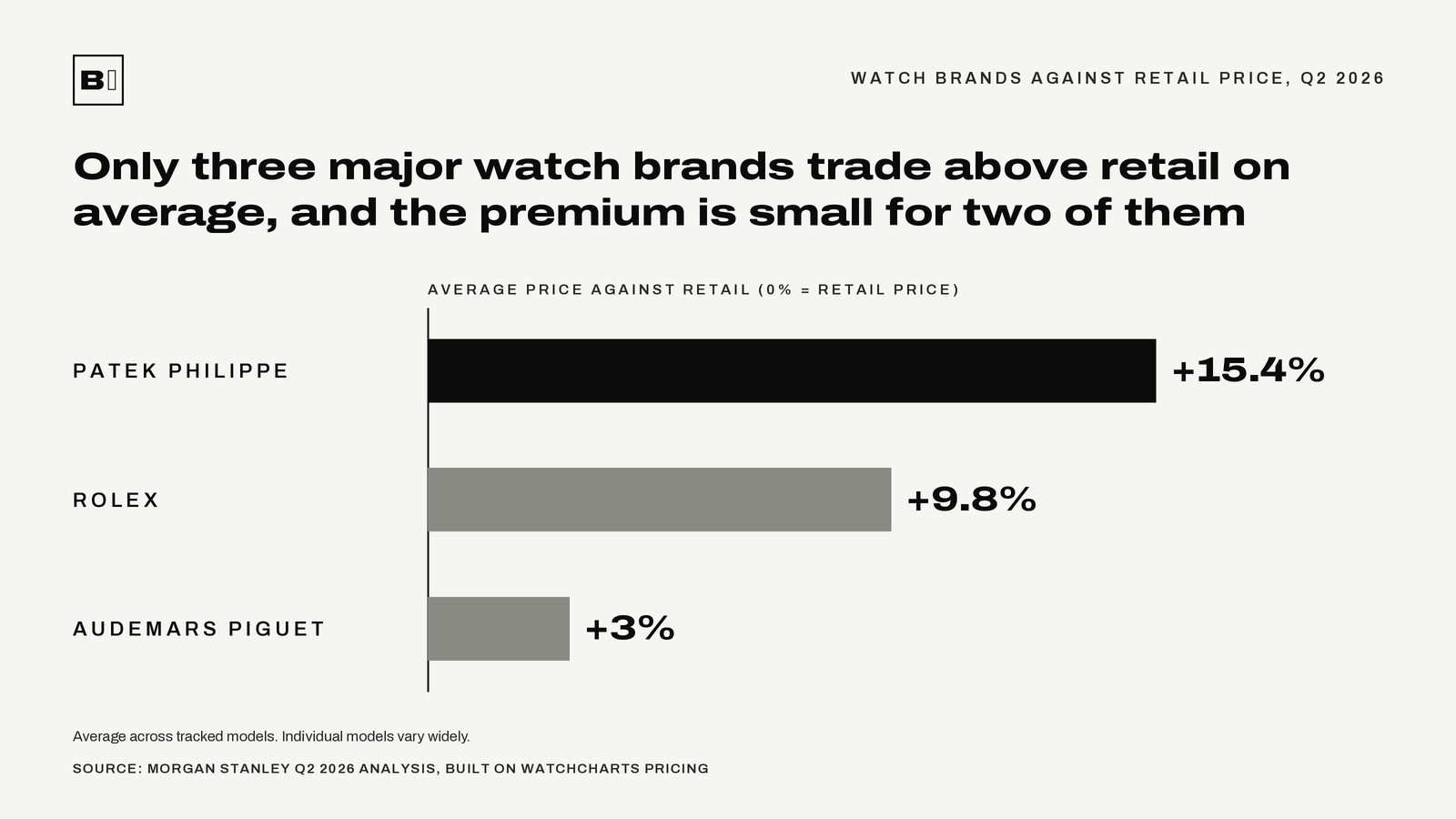
A more useful lens is price against retail. A Q2 2026 analysis from Morgan Stanley, built on WatchCharts pricing, found only three major brands trading above retail on average: Patek Philippe by the most (about 15 per cent), then Rolex and Audemars Piguet, which sat only slightly above. The standouts were the Patek Philippe Nautilus, which traded roughly three-quarters over retail, and the Rolex Cosmograph Daytona, about a third over. Some Patek ranges, including the Calatrava and Complications, sat about a third under retail.

Bags: Birkin and Kelly, with Chanel as the comparison
Bags are harder to measure because there is no transaction-level public index like the ones for watches. The main sources are resale platforms' own indices and Knight Frank's.
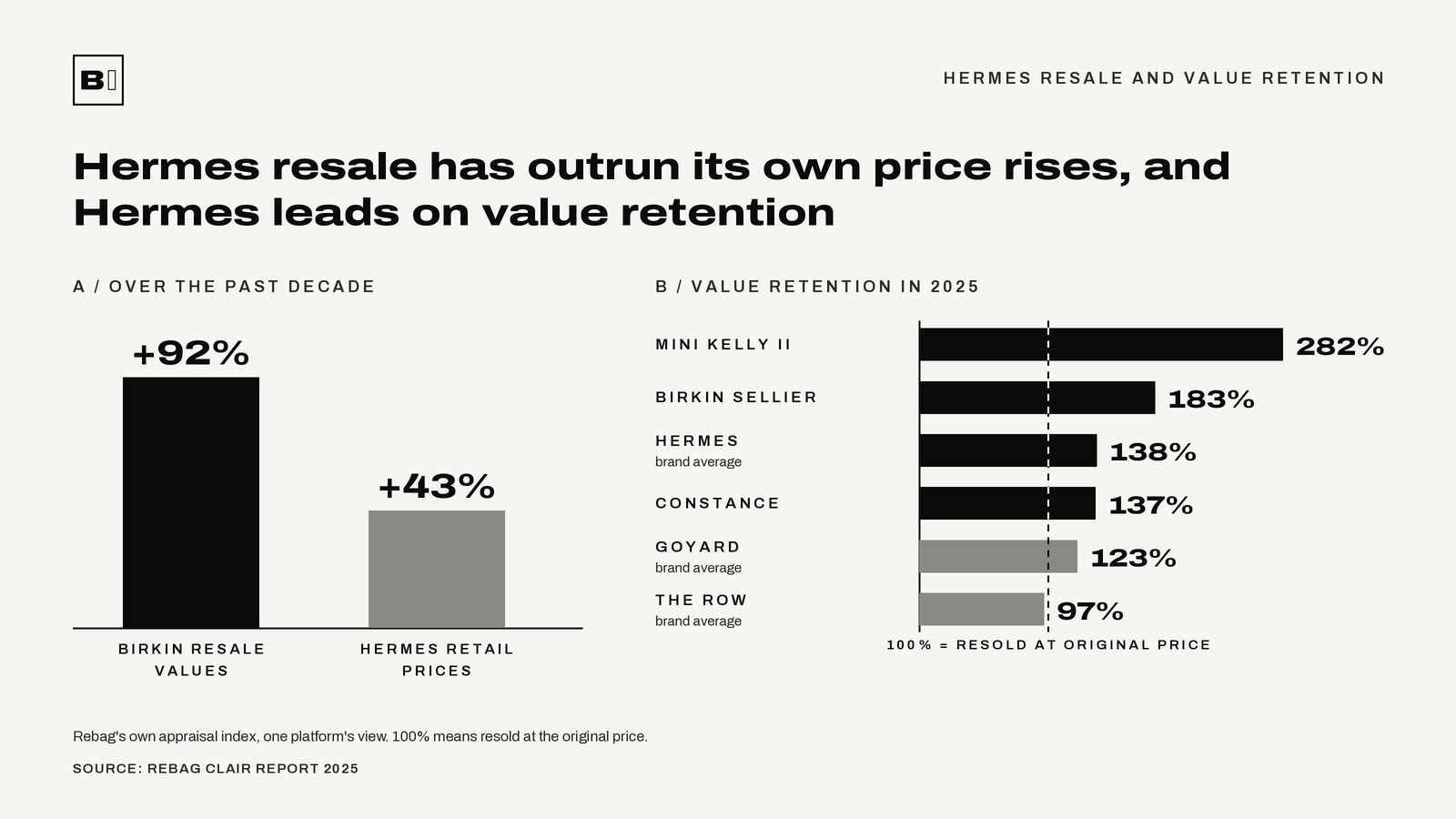
Rebag, a resale platform, reported in its 2025 Clair Report (covered on 11th Dec 25) that Hermes held its value better than any other brand it tracks, with bags reselling for more than their original price on average. Over the past decade, Birkin resale values rose about 92 per cent while Hermes retail prices rose about 43 per cent, so the resale market has run well ahead of the shop price. The Mini Kelly II was the standout, and brands such as Goyard and The Row sat behind Hermes. Rebag uses its own appraisal index, so treat this as one platform's view.
Knight Frank's outlook is not as strong. Its Wealth Report, released on 23rd Apr 26, had Birkin and Kelly bags essentially flat over 2025 (down 0.2 per cent), while its overall luxury index is up about 39 per cent over the decade. Buyers have moved toward pre-owned, visibly worn Birkins. At the other end, Jane Birkin's own bag sold at Sotheby's Paris in July 2025 for US$10.1 million (approx. A$14.5 million), an outlier driven by who owned it.
Part of that resale premium comes from how hard a Birkin is to buy new. Hermes does not sell the bag freely off the shelf, and a proposed US class action filed in California alleged that customers were expected to build a purchase history first, buying items such as scarves, jewellery and homewares before being given the chance to buy a Birkin or Kelly. The plaintiffs also alleged that Hermes misled customers about how available the bags were. A federal judge dismissed the case on 17th Sep 25, finding the plaintiffs had not adequately shown market power or harm to competition, and the plaintiffs have appealed to the Ninth Circuit. These are allegations the court did not test on the facts, and Hermes argued the claims were flawed.
One widely repeated claim comes from resale site Baghunter, whose 2016 study said Birkins beat both the S&P 500 and gold over 35 years. However, unfortunatly different sources quote different figures so for the sake of accuracy I have not published them here. A like-for-like Chanel retention figure from the Rebag report could not be confirmed either for the Chanel Classic Handbag. The Hermes Birkin is the benchmark for the category, and the Chanel flap is its usual comparison.


Against gold and the S&P 500
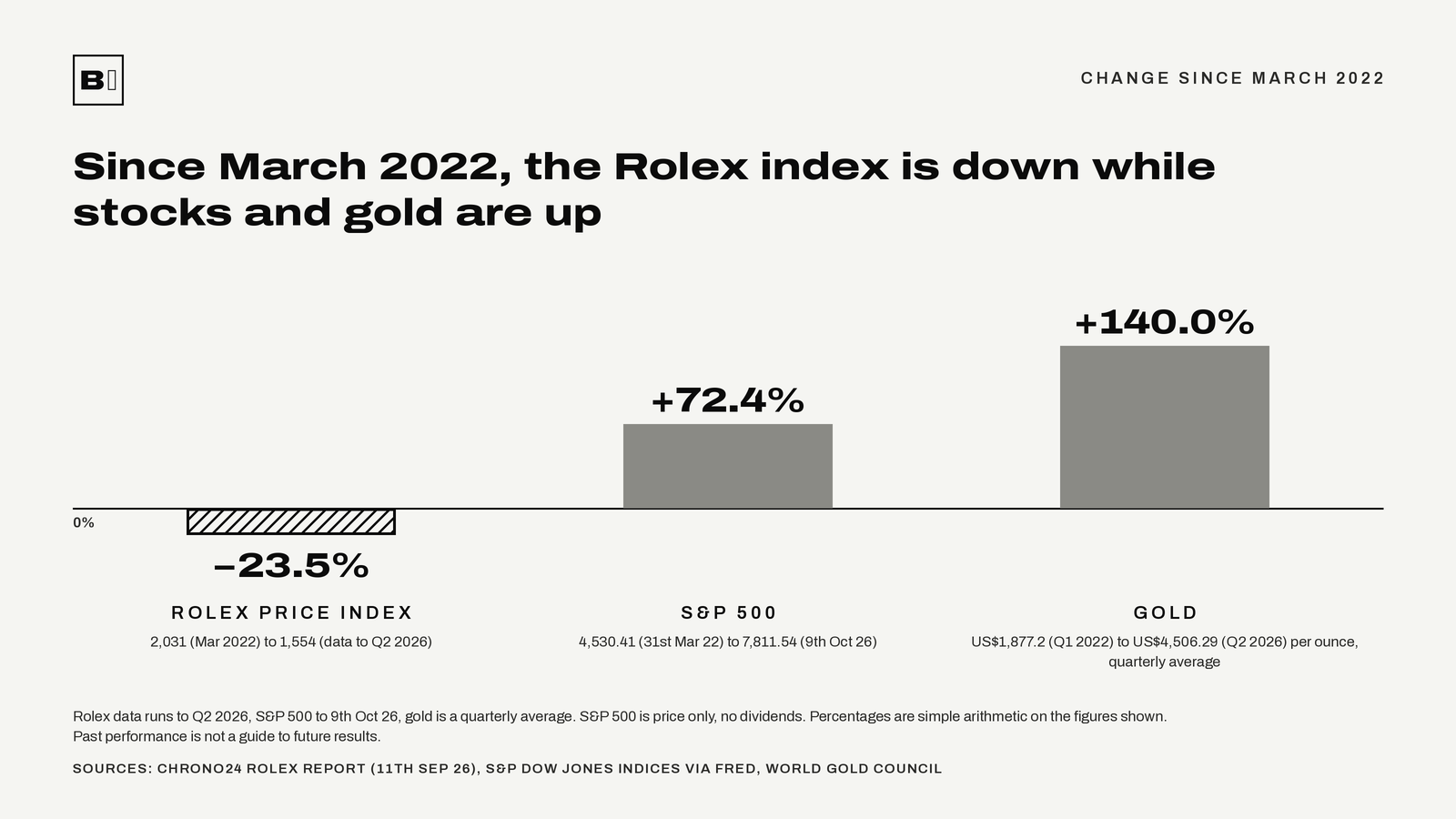
Putting watches, bags, gold and the share market on one chart sounds simple, but nobody publishes all four on the same dates, so treat the comparison below as a rough guide. The first graph shows how the Rolex index, the S&P 500 and gold have grown over time, and the second shows the change since the 2022 peak.
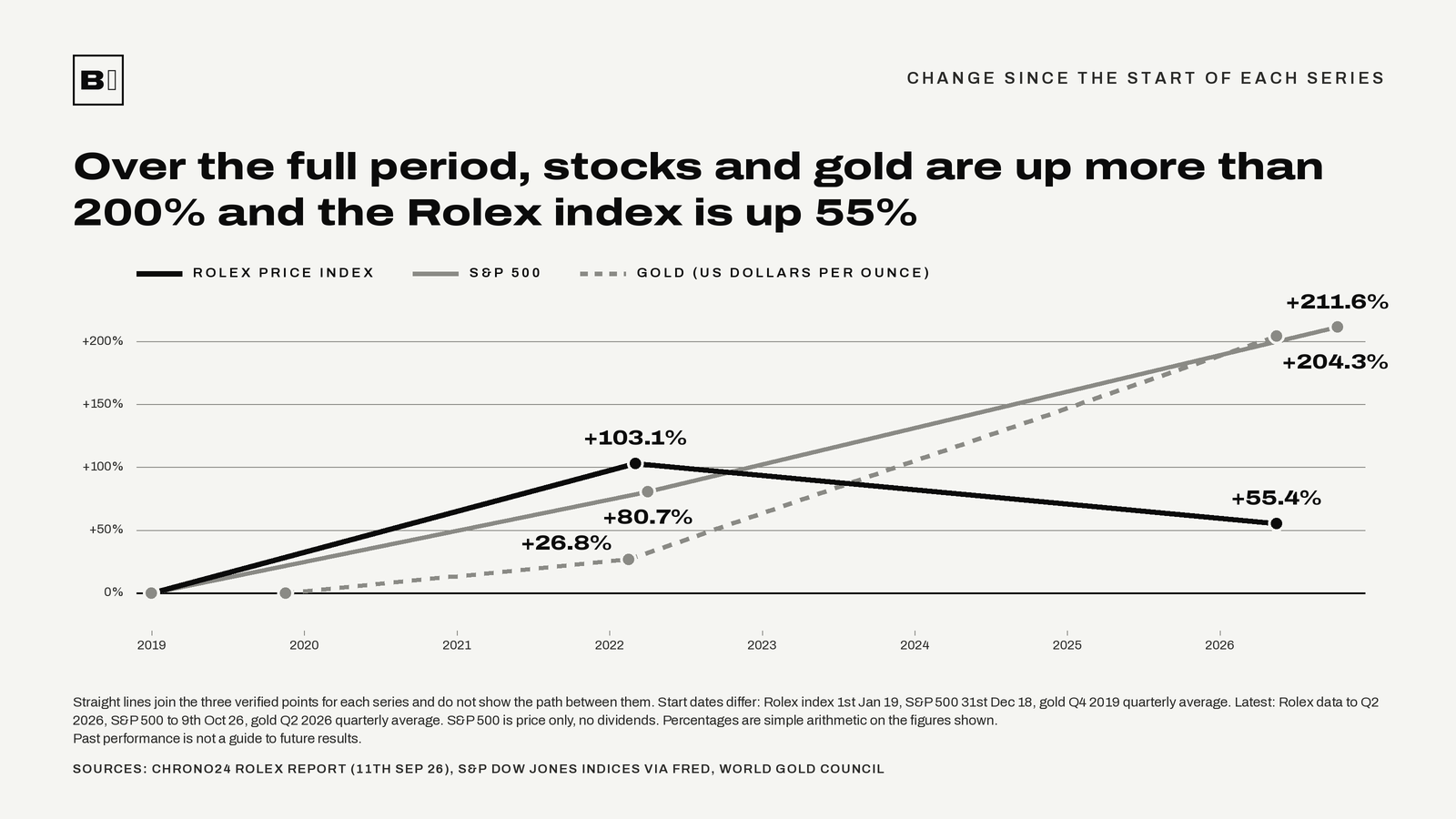
What the graphs do and do not show: the end points are not on identical dates, because the Rolex reading runs to the June quarter of 2026, the S&P 500 figure is from 9th Oct 26 and gold uses quarterly averages, but if gives you a pretty good view on where things are sitting.
Which brands and models held value
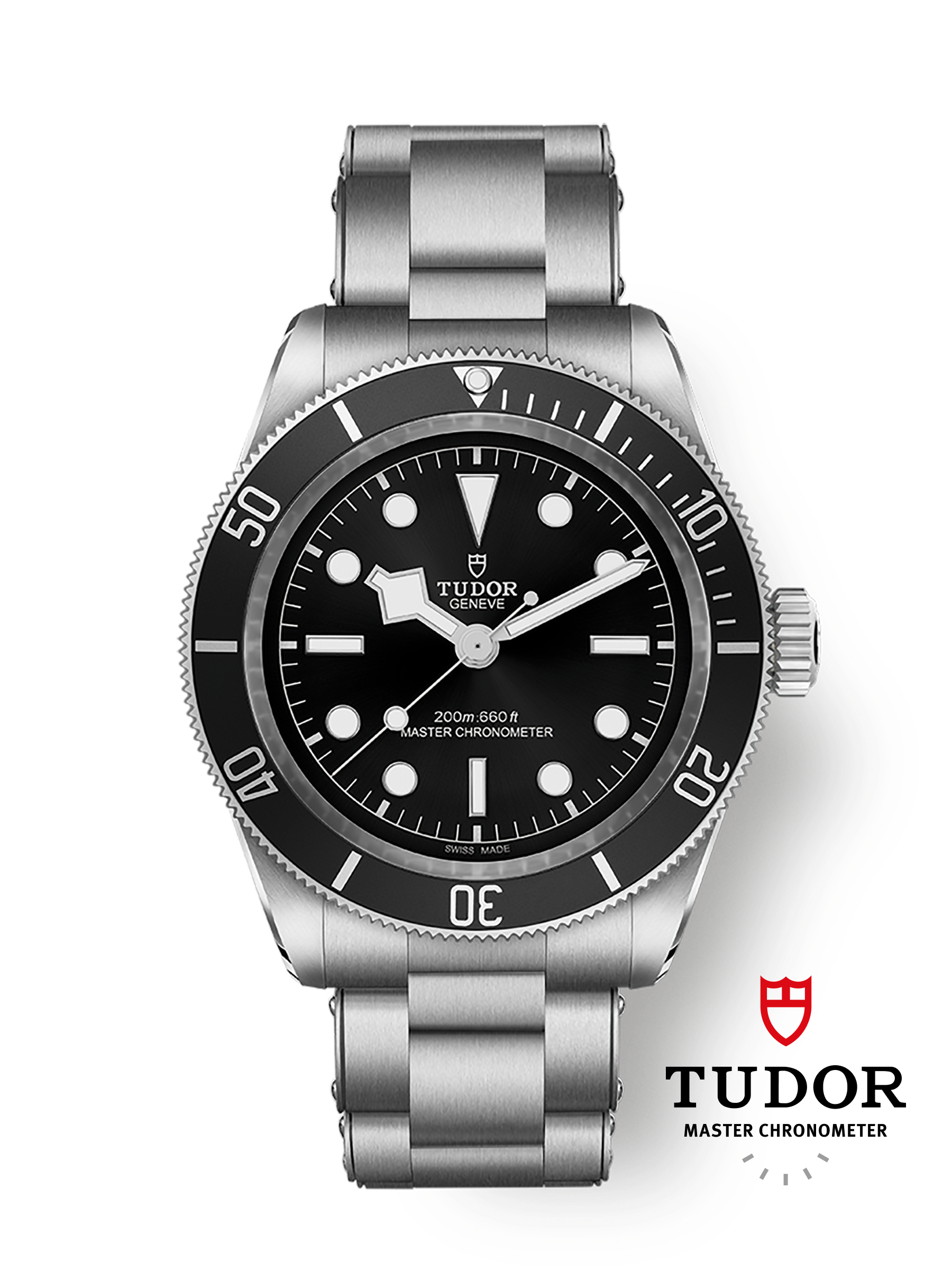
On the evidence above, Patek Philippe has held value best, with Rolex next and Audemars Piguet third. Tudor is the instructive case. Tudor's Black Bay is the brand's best-known line, and Tudor prices rose over the 12 months to February 2026, yet the Q2 2026 analysis still has it roughly a quarter below retail on average. A price can bounce hard from a deep discount and still be well short of what the original buyer paid. Omega and Cartier sit at a similar discount.
Why most watches and bags lose money
The winners are a short list, and the rest of the market trades below what buyers paid new. Several factors explain the gap, some we know but there are hidden costs we tend to forget.
- The buying premium. Paying above retail for a sought-after model means the price has to keep climbing just for you to break even.
- Condition. Scratches, worn corners and missing boxes or papers lower what the next buyer will pay. Knight Frank notes that worn bags now sell well, but at lower prices.
- Servicing. Mechanical watches need periodic servicing, and that cost comes out of any return.
- Authentication and fakes. Verifying a piece costs money, and skipping verification risks buying a fake, and they are very good now.
- Resale fees. Platforms and dealers take commissions or buy below market price, so the price you sell at is not the price you receive.
At a glance
- Rolex price index (Chrono24): well above 2019 and a little higher than a year ago, but still well below the March 2022 peak, which most people anchor their argument to.
- Versus retail, Q2 2026: only Patek Philippe, Rolex and Audemars Piguet trade above retail, with Patek the furthest ahead.
- Bags: Birkin resale has outpaced Hermes retail prices over the decade (Rebag), but Birkin and Kelly were flat over 2025 (Knight Frank).
- Benchmarks: since March 2022 the S&P 500 and gold are both out performed Rolex.
- Costs to weigh: buying premium, condition, servicing, authentication, resale fees and fakes.
Verdict: As a pure investment, the numbers are patchy. A small group of references have held or grown their value, but most watches and bags sell for less than they cost, and since March 2022 the S&P 500 and gold have both climbed faster than luxury resale. Every wear or carry takes a little more off what the piece will fetch later. But nobody buys a Birkin or a Rolex with a spreadsheet alone. Part of the value is how it makes you feel, and no index can measure that. If you can afford it, love it and can live with losing some of what you paid, then go for it. If you are only buying it to sell later, maybe there are better investments.
Past performance is not a guide to future results. This article is general information about a market and is not financial advice.